


THE SHORT STORY
A company built to move needed a brand that moved with it.
For more than three decades, DriveShop had built deep relationships across the automotive industry, managing fleets, creating experiences, connecting brands with creators and media, producing content, and developing technology that turns activity into measurable results.
The substance was there.
The opportunity was to make the brand feel as dynamic as the company behind it.
Working alongside executive leadership and the internal design team, I helped establish a new creative direction for how DriveShop looked, sounded, and presented itself. Together, we explored ideas in real time, challenged how the company told its story, and rapidly translated those conversations into a new visual system and comprehensive go-to-market deck.
The goal:
Make every pitch, post, deck and event feel unmistakably DriveShop.
THE CHALLENGE
A lot to say. One brand to say it.
DriveShop wasn't suffering from a lack of capability.
It was almost the opposite.
The company operated across fleet management, experiential, creator partnerships, content production, editorial, technology, paid media and measurement with relationships spanning some of the world's most recognizable automotive brands. The deck itself needed to communicate that breadth while making the company easier, not harder, to understand.
At the same time, new leadership was helping define the company's next chapter.
The challenge was to create a creative system capable of bringing all of it together without losing the credibility DriveShop had spent decades building.
How do you evolve an established company without losing what made it valuable in the first place?

THE STRATEGY
Don't be louder. Be clearer.
One idea quickly became central to the work:
“We don't win by being louder. We win by being clearer, more human, and impossible to ignore.”
That thinking gave us a filter for both the brand and the presentation.
Rather than treating DriveShop as another automotive services company defined by capabilities and specifications, we began building a story around what those capabilities actually create:
Movement.
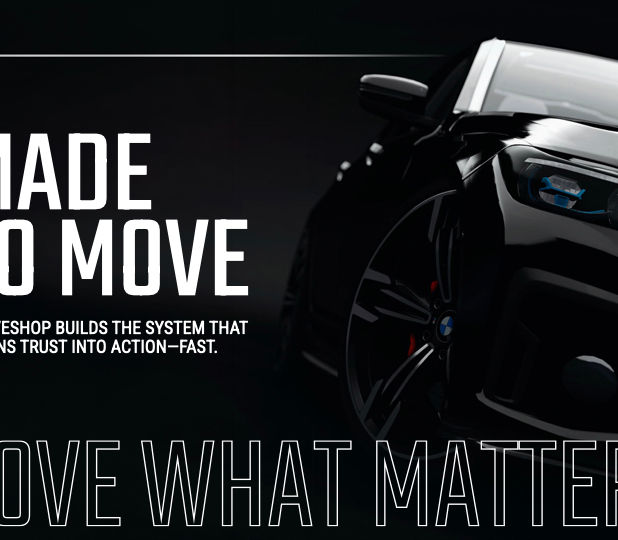
Move trust into action.
Move drivers into buyers.
Move rides into romance.
Move curiosity into desire.
Move stories into shoppers.
“Move” became more than a recurring headline. It gave the company a verbal framework capable of connecting very different parts of the business under one idea.

FINDING THE HUMAN STORY
Behind every machine is a human decision.
Automotive marketing has no shortage of horsepower, performance claims and beautiful machines.
But people don't experience buying a vehicle as a spec sheet.
It's a first-time buyer doing the math twice. A new parent thinking about what safety means differently now. A teenager imagining freedom. A contractor depending on a truck to show up every morning.
Those aren't product decisions.
They're life decisions.
That insight helped push the creative direction away from conventional automotive marketing and toward something more editorial, emotional and human, creating a brand that could still celebrate the machine without forgetting the person behind the wheel.


THE CREATIVE
Building a brand with somewhere to go.
I helped bring the new direction to life across the system, developing visual concepts, sourcing and creating imagery, exploring typography and composition, building layouts and mockups, and establishing creative guardrails that could give the brand greater consistency without making it feel rigid.
The visual language became bolder and more editorial.
Black-and-white photography brought humanity and attitude. Automotive imagery became cinematic rather than purely descriptive.
Condensed typography created movement and urgency. Oversized language, layered compositions and deliberate moments of restraint gave the work rhythm.
The objective wasn't simply to make DriveShop look different.
It was to give the company a creative language flexible enough to tell many stories while still feeling like one brand.


FROM CONVERSATIONS TO CREATIVE
Ideas didn't sit around waiting for a presentation.
The work moved quickly.
I collaborated directly with executive leadership and the design team, brainstorming ideas, exploring positioning and translating conversations into visual concepts, often in parallel.
An idea discussed in a meeting could quickly become a headline, layout, mockup or new section of the presentation. That allowed the team to react to something tangible, refine the thinking and keep moving.
Strategy informed design.
Design helped sharpen the strategy.
That rapid exchange allowed us to develop the brand direction while simultaneously building the tool leadership needed to take it into the market.
ONE COMPANY.
ONE SYSTEM.
Turning complexity into a story people could follow.
One of the largest challenges was organizing the breadth of DriveShop's offering into something cohesive.
The resulting presentation introduced a connected ecosystem:
Experience. Collabs. Studio. Editorial. Amplify & Attribute.


Supported by fleet infrastructure, proprietary technology, budgeting and measurement, those capabilities could now be presented as parts of one operating system designed to move trust into action.
The deck moved from brand belief into capabilities, technology, national infrastructure, creators, case studies, measurement and implementation—giving leadership a flexible narrative for both internal alignment and external conversations.
Five Shops. One System. One DriveShop.
THE GO-TO
MARKET DECK
More than just a presentation.
The final deck became a working expression of the brand's next chapter.
Across more than 50 pages, the system had to move seamlessly between emotional storytelling and complex business information, from manifestos and campaign thinking to fleet operations, proprietary AI, creator ecosystems, measurement, pricing and implementation.
That meant designing for more than aesthetics.
The deck had to sell. Explain. Align. And move.
It gave leadership a tool they could put to work immediately while creating a foundation for how DriveShop could continue showing up across future presentations, pitches and brand communications.

Why It Matters
Some of the most interesting creative challenges aren't about inventing something new.
They're about seeing what's already there more clearly.
DriveShop already had the experience, relationships, technology and capabilities.
The opportunity was to help connect those pieces into a brand people could understand, and a story leadership could confidently tell.
Because sometimes a brand doesn't need to become something different.
It needs to show the world what it has become.